
Music theory for guitarists
Music theory can be confusing, there's a lot of information to unpack. This page will introduce you to an approach to music theory that will help you learn how to navigate the fretboard of your guitar.
The Chromatic Scale:
The chromatic scale is a term that describes all of the notes that are possible to play on the fretboard. It consists of all 12 notes, each 1/2 step apart. This can be visualized in ascending order below:
A - B C - D - E F - G -
Where each "-" represents a sharp or flat note. A sharp (A#) is 1/2 step above A, and B flat (Bb) is 1/2 step below B. A# is the same note as Bb, and so on. Notice that C is 1/2 step above B, and F is 1/2 step above E.
Interval Theory:
Most western music uses the diatonic scale. This is an 8 note scale, from octave to octave, where the 8th note is one octave higher than the 1st note. Each note in the scale is called a step and is assigned a number according to its position in the scale. ie. the "3rd" is the 3rd note in the scale. There are two types of steps: perfect and intermediate. The perfect and intermediate steps are listed below:
Perfect Steps: 1, 4, 5, 8
Intermediate Steps: 2, 3, 6, 7
The standard major scale follows the following steps:
1 2 3 4 5 6 7 8
R F F H F F F H
R = Root
F = Full Step
H = Half Step
Recall the notes listed in the chromatic scale earlier, if we choose C as our root note and list the notes for the C major scale we will get:
C D E F G A B C
1 2 3 4 5 6 7 8
important note: the first step (1) will always correspond to the root note of the scale.
Intermediate steps:
Playing C to E would be a major 3rd interval. If we decide to play 1/2 step lower, Eb, that is called a minor 3rd. This applies to the 6th step as well.
Perfect Steps:
Playing C to G would be a 5th interval. If we decide to play 1/2 step lower, Gb, that is called a diminished 5th. If we play 1/2 step higher, G#, that is called an augmented 5th. This applies to the other perfect steps and the 2nd and 7th as well.
The Pentatonic and Diatonic Scale:
The pentatonic scale is a 5-note scale that contains the 1, 3, 4, 5, 7, and 8th steps of the diatonic scale we've discussed thus far. The shapes of these scales are important to memorize and will eventually become second nature to play. Practice moving up and down them and get comfortable with the shapes. We will see how they apply more in-depth later on. The scales have been arranged so you can see how the notes fall on top of each other as you move from position to position. Remember that the 8th step is the same note one octave above the 1st, so 8 is equal to 1 as you continue up the scale. I recommend getting comfortable with the pentatonic scale first, then filling in the rest of the notes in the diatonic scale as the scale shapes become more natural. The pentatonic is on the left and the diatonic is on the right.

Modes:
Modes refer to different "flavors" of scales contained within the diatonic scale. The different modes are:
I = Ionian = Natural major
D = Dorian = Minor with major 6th
P = Phrygian = Minor with diminished 2nd
L = Lydian = Major with augmented 4th
M = Mixolydian = Major with minor 7th
A = Aeolian = Natural Minor
L = Locrian = Diminished
This is a lot of scales, and a lot to take in. However, it can come easily because to play them all you only need to know that one diatonic scale that we've talked about.
Let’s look at an Ionian Major scale:
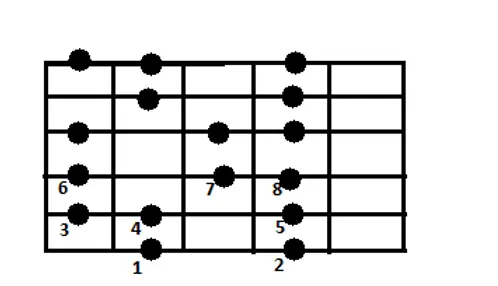
This chart has each step in the scale marked. This is the Ionian major scale, and because all modes are related we can get any mode from the shape of this scale as well. To do this, we simply change which note is our root note. If the root note of the scale shown above is a C and using this same shape we decide that D (the 2nd note) is now the root note, then we have entered the Dorian mode in the key of D.
This is illustrated below. Notice that the shape has stayed the same but the root note is now a full step higher and the intervals have shifted to be a Dorian mode scale.
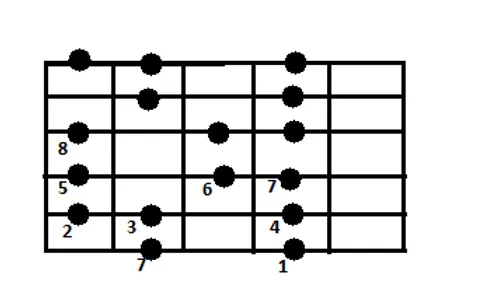
The C Ionian scale is the same as the D Dorian scale, this means that they are relative modes or keys. Playing in different modes can help you achieve different feeling and sound in your music.
The table below shows how moving the root note in the ionian scale translates to the new mode you've entered.

We can take the Ionian scale shape and shift the root to any of these steps and change to that relative mode.
I.e. C Ionian = D Dorian = E Phrygian = F Lydian = G MixoLydian = A Aeolian = B Locrian
You may hear people talk about relative majors and minors. This corresponds to Ionian (major) and Aeolian (minor). The Relative major is always 3 frets above the minor root. I.e. A minor is relative to C major.
